We built a tool that evaluates landing pages. At some point we had to ask the obvious question: what does it say about ours?
On March 12, 2026, we ran a full BuyerEyes audit on buyereyes.ai. 14 agents, 29 sub-scores, 10 buyer personas. The results were uncomfortable enough that we published them here instead of quietly fixing things in the dark. This audit looked at the page alone. Paid traffic adds a failure mode it cannot see: when the ad and the landing page disagree.
The audit results
Six dimensions, one composite score.
The overall score is held down almost entirely by Trust (4.5) and Visual (5.0). The primary bottleneck identified by the synthesis agent: Trust & Credibility. The site reads as anonymous. No contact information. No visible social proof. No founder photo. Copy is strong; the page just doesn't feel safe to buy from.
What the audit found
Five agents flagged issues independently. The debate rounds confirmed all of them. Here are the six findings that drove the remediation plan.
No contact information anywhere on the page
The automated inventory returned "NONE FOUND" for header and footer contact info. No email, no address, no support link. For a B2B service asking customers to pay $49-$399, this signals zero accountability.
No visible social proof or testimonials
The audit found no testimonials, case studies, or third-party review badges on the homepage. For a B2B service asking $49-$399, the absence of any social proof makes the purchase feel risky. This was flagged as the single highest-leverage fix available.
3 competing primary CTAs above the fold
Three distinct conversion actions competed for attention before the first scroll. The CTA agent called it a decision paralysis risk. One primary action per screen is the standard; we had three.
3,726 words, methodology explained five times
The same methodology explanation appeared across five separate sections: "How it works," "Scoring methodology," "Credibility," "Why it works," and "FAQ." Copy scored 9.5/10 for quality. Length and redundancy were pulling engagement down.
Mobile CTA hidden from screen readers
The mobile sticky CTA container had aria-hidden="true" set while remaining focusable. Screen reader users could tab into it but receive no announcement. An accessibility trap, not just a compliance note.
Analytics script inflating load time to 73.8 seconds
LCP measured 268ms - the page was fast. But the fullyLoaded metric hit 73.8s because a background analytics script kept the page in a loading state. This doesn't affect user experience directly but distorts performance monitoring.
The fix timeline
We ran four rounds of changes. Each round used the previous audit findings as the brief. The goal was to move Trust above 7.0 and overall above 78.
- Added review carousel with named testimonials and photo placeholders
- Introduced a credibility bar with trust indicators above pricing
- Improved visual hierarchy in the hero section
- Added transparency section with real audit data near the CTA
- Consolidated three above-fold CTAs into one primary action
- Added pricing anchor near the hero to reduce scroll distance
- Moved the sample report link to a secondary position
- Reduced word count by ~600 words through section merges
- Added sticky header that appears on scroll (reduces CTA distance)
- Improved color contrast on calculator labels (2.35:1 → 4.5:1+)
- Rewrote CTA microcopy to include specific outcome language
- Added "no subscription" reassurance near pricing
- Added contact email and support link to the footer
- Expanded testimonial section to show 4 named reviews with results
- Added founder section with photo, name, and LinkedIn link
- Fixed
aria-hidden="true"on mobile sticky CTA container - Removed analytics script causing 73.8s fullyLoaded time
Before and after
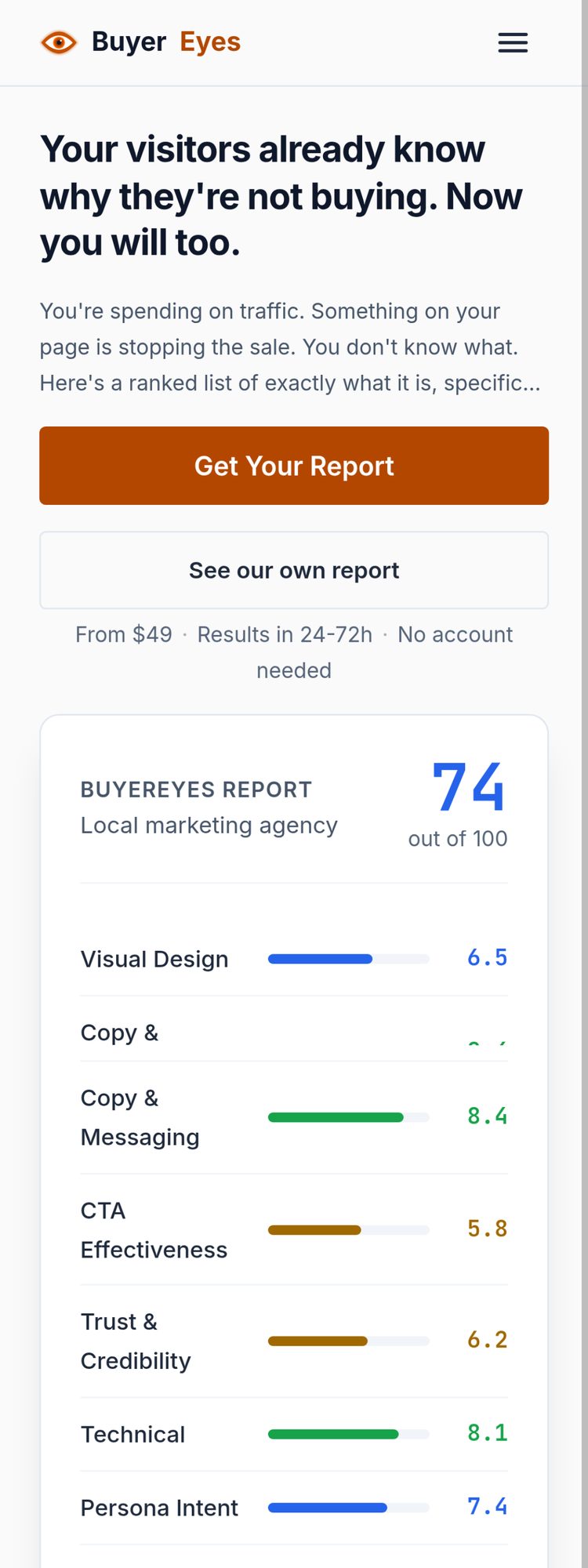
Screenshots captured before Round 1 changes and after Round 4.
Score comparison
Scores from the March 12 baseline audit vs. the targets we set for Round 4. Re-audit scheduled after all Round 4 changes are live.
| Dimension | Baseline (March 12) | Target | Gap |
|---|---|---|---|
| Overall | 68 / 100 | 78+ | +10 |
| Trust | 4.5 / 10 | 7.0+ | +2.5 |
| Visual | 5.0 / 10 | 6.5+ | +1.5 |
| Copy | 9.5 / 10 | 8.5+ (shorter) | reduce length |
| CTA | 7.5 / 10 | 8.0+ | +0.5 |
| Technical | 8.1 / 10 | 8.5+ | +0.4 |
| Persona avg | 5.6 / 10 | 6.5+ | +0.9 |
Trust is the bottleneck that limits everything else. A page scoring 9.5 on copy still fails to convert if visitors don't trust who they're buying from. The personas confirmed this - most ended Round 1 in "validation mode," looking for the sample report rather than going to pricing. That behavior shifts when trust signals are present.
Want to see what BuyerEyes finds on your site?
Same audit. 14 agents. 29 sub-scores. Real findings, not generic feedback. Report in 24-48 hours.
View pricing and order a report